


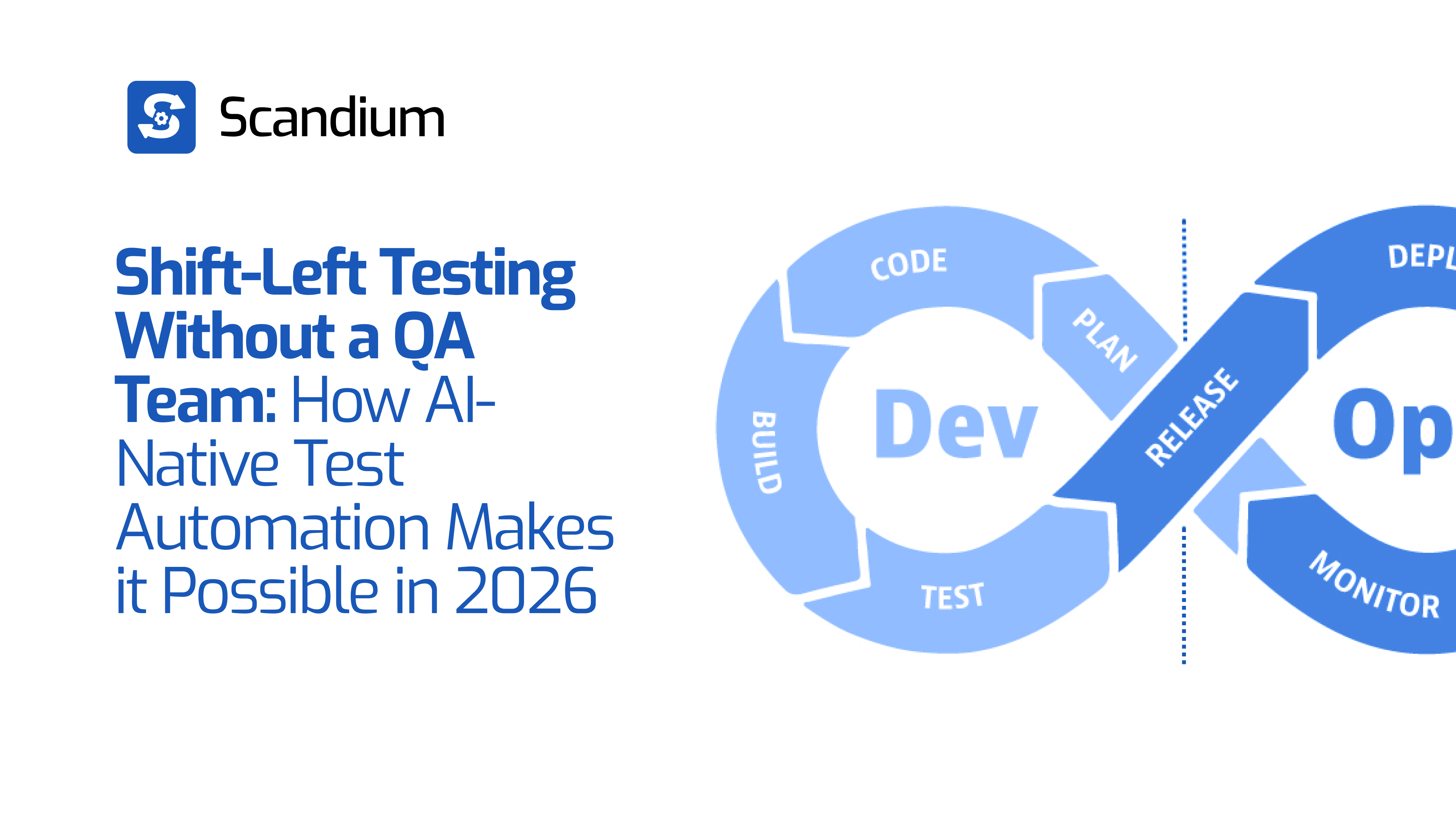
For years, “shift-left testing” has been treated as a best practice; something every modern engineering team should strive for. The idea is straightforward: test earlier, catch issues sooner, and reduce the cost of fixing defects.
But there has always been a hidden assumption behind it.
That you have a QA team.
In reality, many teams today, especially startups, lean product teams, and developer-led organisations, don’t. And even when they do, QA often becomes a bottleneck rather than an enabler.
In 2026, that assumption is starting to break.
AI-native test automation is redefining how testing happens, making it possible to shift left without relying on a dedicated QA function. And at the centre of this shift is a new class of tools, including the Scandium suite and Rova AI, designed to embed quality directly into how software is built.
Why Shift-Left Testing Has Struggled Without QA
The problem has never been awareness. Most teams understand the value of testing early.
The problem is execution.
Traditional approaches to testing still depend heavily on manual effort:
- Writing detailed test cases
- Translating them into automation scripts
- Maintaining those scripts as the product evolves
For developers, this quickly becomes a burden. Writing tests is one thing; maintaining them is another entirely.
Without a QA team to own this process, test suites tend to degrade over time. They become flaky, outdated, or simply ignored. As a result, teams fall back into reactive testing, catching issues late in the cycle.
So while the idea of shifting left sounds appealing, the reality has been difficult to sustain.
The Shift to AI-Native Testing
What’s changing in 2026 is not just automation; it’s the level at which automation operates.
AI-native testing tools move away from step-by-step scripting and toward goal-driven execution. Instead of telling the system exactly what to do, teams define what needs to be tested, and the system handles the rest.
This fundamentally changes the role of testing in development.
With tools like Rova AI, for example, a developer can simply define an objective such as testing a signup or checkout flow. The system then navigates the application, interacts with elements, adapts to UI changes, and identifies issues, all without requiring predefined test steps.
This removes one of the biggest barriers to shift-left testing: the need to create and maintain test cases manually.
From Test Cases to Test Intent
Traditional testing workflows revolve around instructions.
AI-native testing revolves around intent.
This shift may seem subtle, but it has significant implications.
Instead of writing:
Click this button → enter this value → verify this outcome
Teams now define:
Test the onboarding flow
From there, the system explores possible paths, handles variations, and surfaces issues. It doesn’t just validate expected behaviour; it actively searches for problems.
This approach makes testing more accessible, especially for teams without QA specialists. Developers, product managers, and even non-technical stakeholders can participate in testing without needing deep expertise in automation frameworks.
How the Scandium Suite Enables Shift-Left Testing
The shift toward AI-native testing isn’t powered by a single tool; it requires an ecosystem that supports different stages of the testing lifecycle.
This is where the Scandium suite comes in.
Scandium Auto provides AI-powered test automation across web, mobile, and APIs, allowing teams to execute tests without dealing with the complexity of traditional scripting. It reduces the barrier to automation, making it easier for developers to incorporate testing into their workflow from the start.
TestPod complements this by introducing structured, AI-powered test management. Even in teams without QA, there’s still a need for visibility, organisation, and collaboration around testing efforts. TestPod ensures that testing activities are not only executed, but also tracked, managed, and aligned with product goals.
And then there’s Rova AI, which represents the next evolution: autonomous testing. Instead of assisting with testing, it takes ownership of execution based on defined goals. It doesn’t just run tests; it explores the application, adapts to changes, and continuously validates quality.
Together, these tools create a system where testing is no longer a separate phase, but an integrated part of development.
What Shift-Left Looks Like in Practice
In an AI-native environment, shift-left testing is no longer a manual effort; it becomes a natural byproduct of development.
A typical workflow might look like this:
A developer builds a new feature. Instead of writing test cases or waiting for QA, they define a testing goal using Rova AI. The system executes tests immediately, exploring the feature in ways that go beyond predefined paths.
At the same time, Scandium Auto ensures consistent automation across different environments, while TestPod provides visibility into what has been tested, what issues were found, and how quality is evolving over time.
Testing happens:
- During development
- Before merges
- As part of CI/CD pipelines
Not as a separate activity, but as a continuous process.
Reducing Maintenance Overhead
One of the biggest challenges in traditional test automation is maintenance.
Test scripts often rely on fragile selectors and rigid workflows. Even minor UI changes can cause tests to fail, requiring constant updates.
AI-native systems approach this differently.
Because they operate at a higher level of abstraction, they are better equipped to adapt to changes:
- They identify elements more intelligently
- They adjust to layout or structural updates
- They regenerate test paths when flows evolve
This drastically reduces the time spent maintaining tests; a critical advantage for teams without QA resources.
Expanding Testing Beyond QA Teams
Perhaps the most important impact of AI-native testing is that it democratizes quality.
Testing is no longer limited to QA engineers. Developers can validate their own work. Product managers can verify user flows. Founders can test critical paths without needing technical expertise.
This doesn’t eliminate the value of QA; it redistributes responsibility.
Quality becomes a shared concern, supported by systems that make testing accessible and scalable.
Rethinking the Role of QA
As AI-native tools take over execution, the role of QA evolves.
Instead of focusing on writing and maintaining test cases, QA professionals can shift toward:
- Defining testing strategies
- Identifying high-risk areas
- Interpreting insights from AI-driven testing
- Ensuring overall product quality standards
In teams without QA, tools like Rova AI fill the gap. In teams with QA, they enhance productivity and impact.
The Future of Shift-Left Testing
Shift-left testing in 2026 is no longer about pushing testing earlier in the timeline.
It’s about embedding testing into the development process so deeply that it becomes inseparable from it.
With AI-native tools like Rova AI and the broader Scandium suite, teams can:
- Test continuously without manual overhead
- Catch issues earlier without dedicated QA roles
- Maintain coverage without constant maintenance
The result is a more resilient, scalable approach to quality.
Final Thoughts
For a long time, shift-left testing has been constrained by the realities of manual effort and team structure.
AI-native automation removes those constraints.
It allows teams, regardless of size or composition, to build quality into their products from the very beginning.
And in doing so, it challenges a long-standing assumption: Effective testing requires a dedicated QA team.
In 2026, that’s no longer necessarily true.
